Showing posts with label libraries. Show all posts

Thursday, February 5, 2009

Librarians on Street Lit


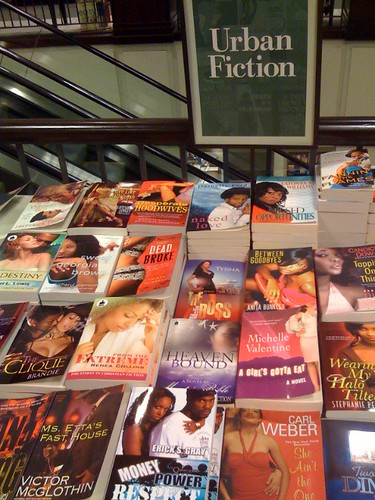
Brooklyn and NYPL librarians recently ran a survey about street lit (what is it? here's Wikipedia's entry), and they've written up the results in the most recent issue of School Library Journal. Some findings:
  • 49% of the respondents worked in urban libraries, 43% in suburban libraries, and 8% in rural libraries. 92.5% offered street lit in their collections.
  • Of the 7.5% not offering street lit (and, no, they're not all from rural areas!), 50% say it's because there's "no patron interest."
  • A librarian from urban Ohio wrote, "Our library director does not allow us to buy it because he feels it is inappropriate for our town....I am going to try to sneak some in.”
  • Street lit is often stolen, possibly because some patrons feel embarrassed about checking it out. To help solve this problem, the authors say librarians should shelve street lit where it's easy to find and be ready to answer questions about it openly and cheerfully.
  • An encouraging result, the authors write: "One thing we hoped our survey would show is that street lit is bringing nonreading teens into the public library—and that appears to true. Indeed, librarians are actively using street lit as a jumping-off point to create relationships with teens. As a librarian in an urban California library wrote, 'Talking about urban fiction with teens is a great way to get to know them… Having read some of the titles and/or at least being familiar with them helps to start the relationship.'"
For the full article, and examples from the "street lit canon," click here. And here are street lit resources for librarians--including lists of publishers and popular titles for teens.

Creative Commons image from satanslaundromat on Flickr.

Why Do You Go to the Library?


In the most recent issue of Publishing Trends, we wrote about book rental companies BookSwim, Booksfree, and Paperspine. Read the article here.

The comment that leapt out at me during the interview process and has stuck in my head since I wrote the article was from Doug Ross, CEO of Booksfree, who said:

"When you go into a library, more than half the space is taken up with entertainment product. Mass market paperbacks and hardcovers are all over the place and there's a little bit of room where kids can go in and do research and use computers."
I found the phrase "entertainment product" totally jarring and assumed librarians would hate it, too. But when Ross posted similar comments in a response to a post entitled "Will Libraries Go the Way of Video Stores?" on Strollerderby, the librarians who responded in turn weren't outraged at him. They seemed more irritated by the original post. One commenter, Matthew, wrote:
"Admittedly, I am annoyed by this reoccuring question: 'Will libraries go the way of videostores?' or, phrased another way, 'Have libraries outlived their necessity?'. Both of these questions assume that libraries are primarily about books, and not about information & literacy. All of this assumes that all citizens have the same level of easy access to newer technologies, and that class doesn’t separate us as information consumers."
It's true that I, and most people reading this entry, don't need to use computers at the library because they have their own computers at home and at work. And the realization that librarians themselves think libraries are much more than books is a good reminder that they are many different things to different people. So how ARE people using libraries? The results of a recent Pew survey "challenge the assumption that libraries are losing relevance in the internet age. Libraries drew visits by more than half of Americans (53%) in the past year for all kinds of purposes, not just the problems mentioned in this survey. And it was the young adults in tech-loving Generation Y (age 18-30) who led the pack. Compared to their elders, Gen Y members were the most likely to use libraries for problem-solving information and in general patronage for any purpose."

We'll delve into more of the results of the Pew report in the next post.

PT will still never refer books "entertainment product," though.

Photo: Flickr Creative Commons, Here's Kate, "The Library"